
Sumter County Court Records After a Jail Arrest
After someone is arrested and booked in Sumter County, the case moves from the jail to the court system. The Office of the State Attorney for the Fifth Judicial Circuit reviews the law-enforcement reports and decides what charges to file. Those filed charges open a case, and the case becomes the court record. The Sumter County Clerk of Court keeps that record, which is why a court records search after an arrest goes through the Clerk, not the Sheriff.
The arrest side and the court side answer different questions. For the booking, the holds, and the bond as set at the jail, the jail inmate records page covers the roster, and the jail mugshots page covers the booking photo. The court record covers what the prosecutor actually filed and what the court did with it. Reading both together gives the full picture of a case after an arrest.
How to Find Sumter County Court Records After an Arrest
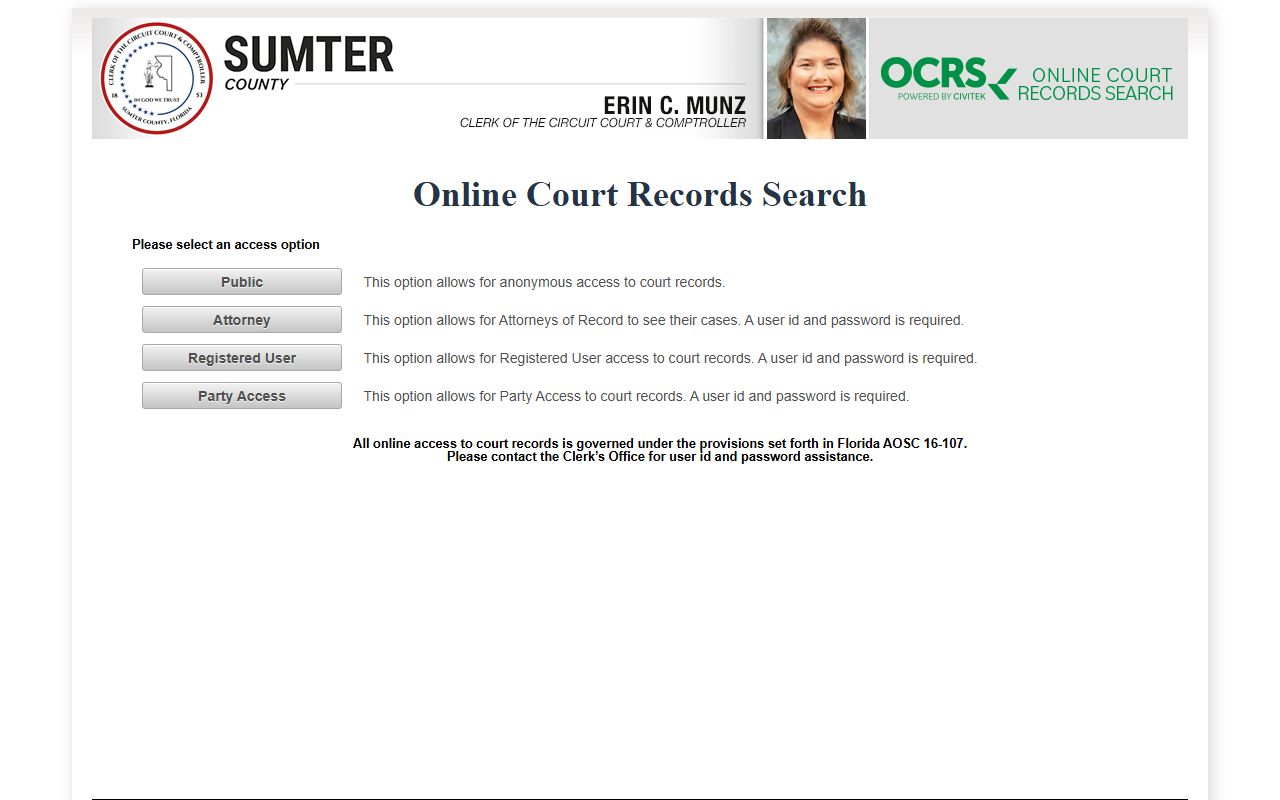
The Clerk of Court publishes criminal case records through an online court records search. The Clerk's site links to the Sumter County portal, which offers public access along with attorney, registered-user, and party logins. Public access is the normal route for general research. The best search starts with anything the jail roster already showed, since a court case number avoids name collisions.
- Open the Sumter County online court records search from the Clerk's services.
- Choose public access, then search by defendant name or by a case number.
- Open the case and read the charge list, hearings, and docket events.
- Check each charge's statute, level, and current status.
The access page sets out the public, attorney, registered, and party options before a search. The court records access page shows those routes.
For a statewide criminal-history check beyond a single county case, Florida has no single combined county docket, so a Sumter case is searched in the Clerk's portal and a formal history is requested from the proper state channel.
A practical search order saves time after a booking. Collect the case number from the roster first if it is shown, then search the court portal by that number to avoid name collisions. If no case number is listed, search by last and first name, and narrow with a date of birth, a booking date, or the arresting agency from the roster. If the case still does not appear, it may be that the booking happened before the prosecutor filed, so wait and search again before assuming no case exists. After that, the Clerk's office or the State Attorney can confirm the status.
Court Case Search Fields and Access
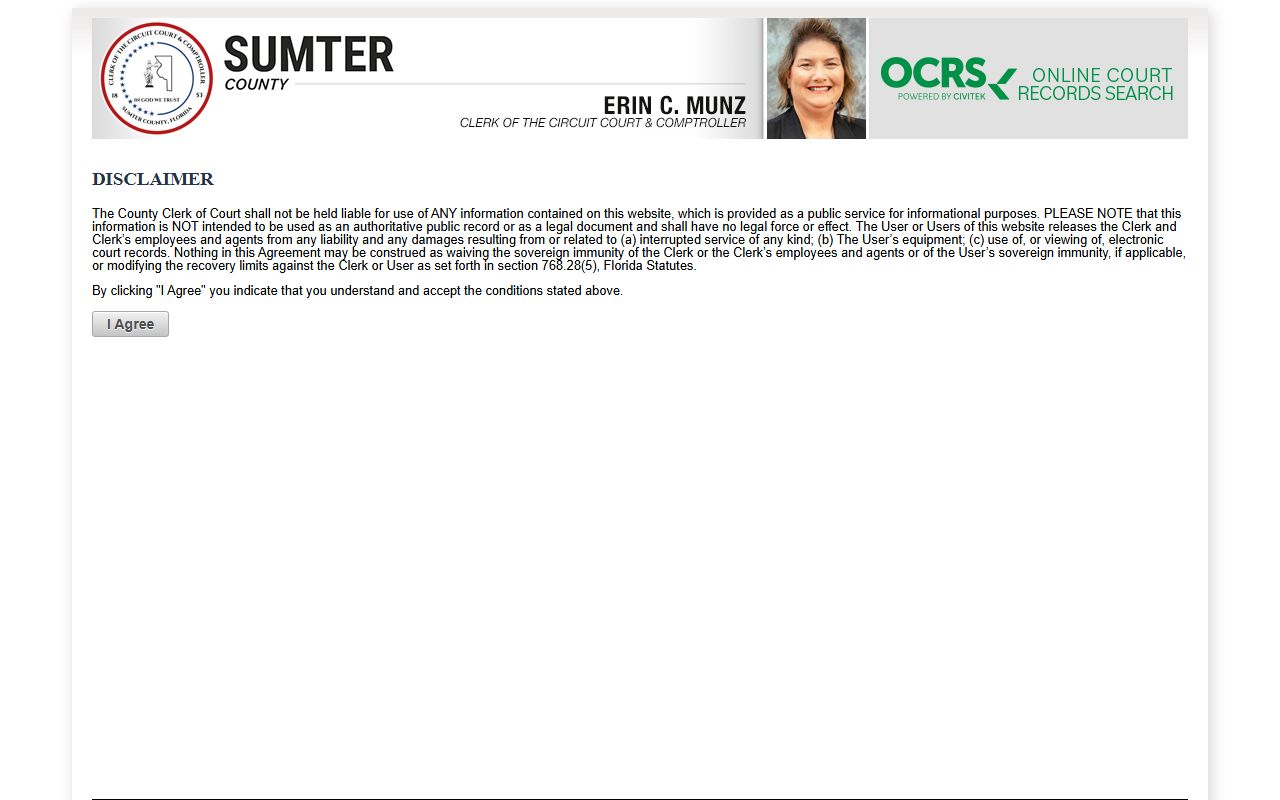
The court records portal opens with an access choice and a disclaimer the user must accept before searching. Public access is anonymous, while attorney, registered-user, and party access need a login and can show more. The table lists the access options on the Sumter County portal.
| Access Option | Login | Notes |
|---|---|---|
| Public | No login | Anonymous access to court records. |
| Attorney | Login required | Attorneys of record see their cases. |
| Registered User | Login required | Expanded registered-user access. |
| Party Access | Login required | Party access to a case. |
The disclaimer screen explains the limits before any record opens. The court records disclaimer says the information is a public service for general purposes and is not an authoritative legal document.
Because the public view is for information only, a certified copy or a filing must come from the Clerk's office directly.
How Charges Get Filed After an Arrest
The path runs from the arrest forward. The booking happens at the jail, and the court charge record begins when the prosecutor files a charging document. In Florida that document is usually an information for many felony and misdemeanor cases, while a grand jury returns an indictment for certain serious offenses. A complaint or probable-cause paperwork can also be part of the early file. The table compares the three main types.
| Complaint | Information | Indictment | |
|---|---|---|---|
| Filed By | Officer / Prosecutor | State Attorney | Grand Jury |
| Common For | Early charging / misdemeanors | Many Florida felonies | Serious felonies |
| Starts | The case | The case | The case |
The State Attorney and the Court Record
Florida uses State Attorney offices instead of district attorneys, and Sumter County falls in the Fifth Judicial Circuit. The State Attorney is the prosecutor who reviews the arrest reports and the probable-cause paperwork and then decides what to file. That office can file an information, decline to file, amend or reduce a charge, add a count, or seek an indictment for a serious offense. The decision is the prosecutor's, not the arresting deputy's, which is the reason a booking charge and a court charge can differ.
For a Sumter County case, the court file itself is searched through the Clerk, while questions about the prosecution belong to the State Attorney's Office. The Fifth Judicial Circuit office publishes its contact details on its own site, and the build here points to that official office rather than guessing a phone or address. Once the prosecutor files, the formal charge, the court dates, the docket events, the plea, and any sentence all appear in the Clerk's court record.
Charge Status and What It Means
Charges change as a case moves. The prosecutor may file fewer charges than the arrest, add charges, amend a statute, or reduce a felony to a misdemeanor. The booking charge on the jail roster is the starting point, and the court docket shows what was filed and what happened next. The table defines the common status terms used in a Sumter County case.
| Status | What It Means |
|---|---|
| Pending | The charge is open and has not been resolved. |
| Amended / Reduced | The charge was changed or lowered after filing. |
| Dismissed | The charge ended without a conviction. |
| Nolle Prosequi | The State Attorney declined or dropped the count. |
| Adjudication Withheld | The court withheld formal adjudication under Florida practice. |
Note: A roster charge can read differently from the filed charge, so do not assume the final charge from the booking line alone; read the Clerk docket for the filed count.
Bond and Release After an Arrest
Bond is usually addressed at the first appearance soon after an arrest. A judge sets release conditions, and the jail roster shows a top-level bond and per-charge bond. A cash bond can be placed at the public lobby kiosk, and a surety bond is posted through a licensed Florida bail bond agent. A hold from another agency can keep a person in custody even when a local bond is payable. The table lists the common bond types.
| Bond Type | How It Works |
|---|---|
| Cash Bond | Money paid directly to secure release; the lobby kiosk can be used. |
| Surety Bond | Posted through a licensed bail bond agent. |
| PR / Own Recognizance | Release on a promise to appear when a court orders it. |
| No-Bond Hold | No release by paying money on that charge or hold until a court changes it. |
Warrants That Lead to an Arrest
An outstanding warrant often explains a booking. An arrest warrant authorizes a new arrest, a bench warrant or capias commonly follows a missed court date, and a violation warrant follows a probation or supervision breach. The Sheriff's Office has a Civil and Warrants division at (352) 569-1670, but no official online warrant search was found, so a warrant is checked through the Clerk's case search, the warrants phone line, and a public records request rather than an aggregator.
Once a person is arrested on a warrant, the jail roster shows the booking, the charge such as failure to appear or a probation violation, and any holds. The court docket shows the warrant or capias event, the missed hearing, the judge's order, and the next court date. The Sheriff's most-wanted page is a public-safety resource and not a complete warrant search.
Charges vs. Convictions
Being arrested and charged is not the same as being convicted. A charge is an accusation that rests on probable cause. A conviction is a verdict or a plea proven to a much higher standard. A booking photo and an arrest charge only show that a person was booked, not that the case ended in a conviction.
| Charge | Conviction | |
|---|---|---|
| Stage | Accusation | Verdict or plea |
| Burden of Proof | Probable cause | Beyond a reasonable doubt |
| Public Record | Yes | Yes |
Sealed vs. Expunged Court Records After an Arrest
Florida law lets eligible records be sealed or expunged after a qualifying outcome. Section 943.0585 sets the eligibility and procedure for court-ordered expunction of criminal-history records, handled through the court and the state. Sealing hides a record from general public view, while expunction goes further. The booking-photo side of this is covered on the jail roster mugshots page.
| Sealed | Expunged | |
|---|---|---|
| Visibility | Hidden from public view | Treated as though it did not exist |
| Law Enforcement | Limited access | Very limited access |
| Eligibility | Per Florida § 943.0585 and related law | Per Florida § 943.0585 and related law |
Background Check Considerations
A casual public-records lookup is not the same as a regulated background check. A formal background check used for hiring or housing must follow the federal Fair Credit Reporting Act and run through a proper consumer reporting agency. The public court portal and the jail roster are reference tools, not screening reports.
Important: This site is not a consumer reporting agency under the FCRA, and its information may not be used for credit, employment, tenant, or insurance decisions.
Restricted Court Records After an Arrest in Sumter County
Not every record is open. Juvenile cases, sealed or expunged charges, and records that a court has closed are restricted under Florida law. Section 119.071 lists exemptions and protected information that can require redaction, and active investigative material may be withheld. The Clerk's administration page says records filed with the Clerk are open for public inspection except those exempt by court order or statute, which is the line that decides what a public search can show.
The public portal is also for information, not for certified documents. The Clerk notes that some older official-record images are being reprocessed for redaction, although the criminal court docket uses a separate court-record system. A person who needs a certified copy, a filed document, or a legally operative record should contact the Clerk's main office in Bushnell rather than rely on a screenshot of the public view.