
Sumter County Jail Roster Overview
The Sumter County Sheriff's Office runs the county jail and its public roster. The roster sits on a SmartWEB Jail View page, lists people held at the Sumter County Detention Center, and shows current detainees plus recent bookings. It is free, and the public results show without a login, even though the page has login fields for staff accounts. The list refreshes as bookings are processed, so a very recent arrest can take a little time to appear.
The roster does not cover every kind of custody. Sentenced Florida prisoners move to the Department of Corrections and show in the state locator. Federal inmates at the Coleman complex show in the Bureau of Prisons locator. Immigration detainees are tracked through ICE. The county roster answers one question well: who is in the Sumter County jail right now or was booked there recently.
How to Use the Sumter County Inmate Roster
The roster lives on the Sheriff's portal and opens to a search form with a recent-bookings view. Have a last name ready before you start. A first name, a middle name, or a booking date helps when a last name is common.
- Open the SmartWEB Jail View roster on the Sheriff's portal.
- Enter at least one search field. Start with the last name, since the page needs at least one criterion.
- Narrow a common name with the first name or a booking date range.
- Open the result to read the booking photo, charges, bond, holds, and housing fields.
The search interface shows the public layout and the recent-bookings feed. The SmartWEB Jail View page displays the search fields above a list of current results.
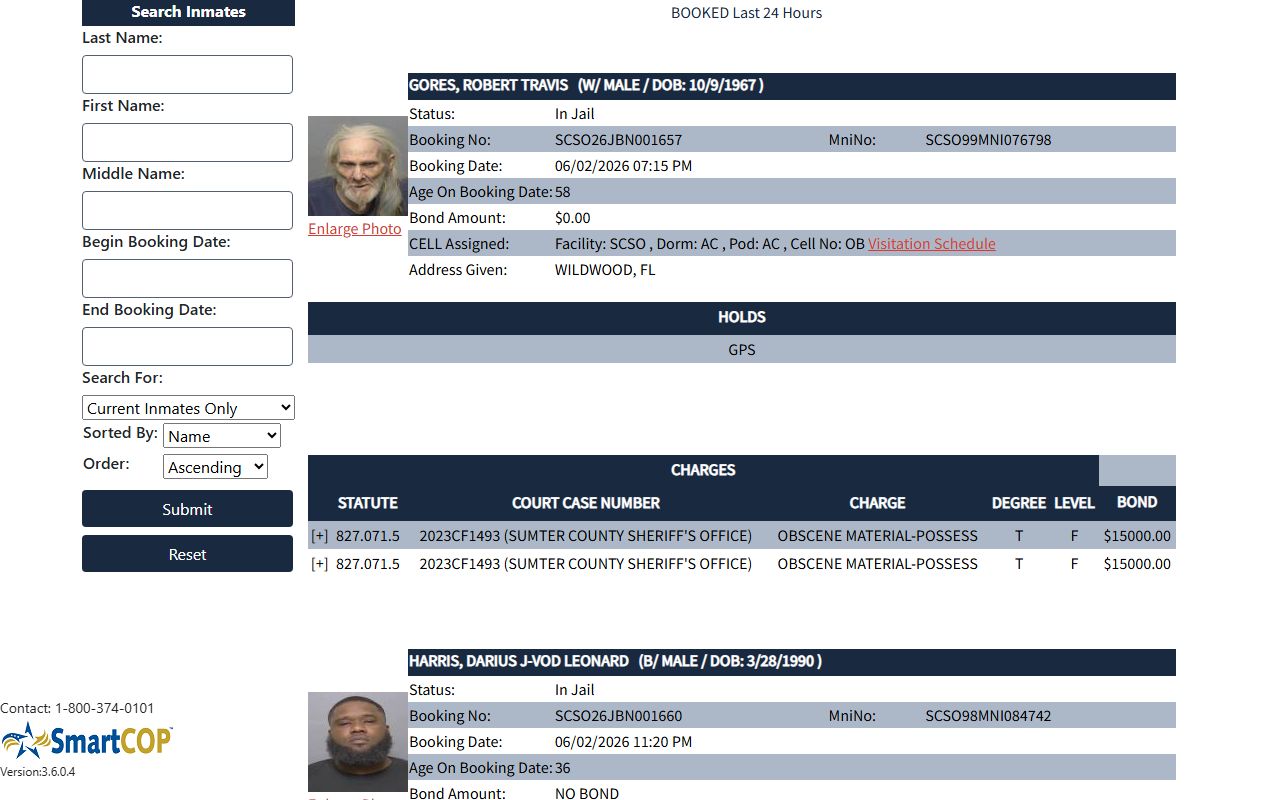
From one result a reader can read the booking number, the charges, and any linked court case number without leaving the page.
Sumter County Roster Search Fields
The public form accepts several fields, and the search needs at least one of them. The most useful is the last name. Booking and release date ranges help when the search is about a recent arrest or a recent release. The table lists the fields the public page and its search links expose.
| Field Label | Type | Required | Notes |
|---|---|---|---|
| Last Name | Text | One field required | Best starting point for most searches. |
| First Name | Text | One field required | Narrows a common last name. |
| Middle Name | Text | One field required | Separates similar names. |
| Begin / End Booking Date | Date | One field required | Use for a known arrest window. |
| Begin / End Release Date | Date | One field required | Use for a recent release. |
| Booking Number | Text | Optional | Format such as SCSO26JBN001649. |
What a Sumter County Inmate Profile Shows
A booking entry is a public custody index, not the full jail file. It shows enough to identify a person and read the basic facts of the custody. Sensitive material such as medical records and victim information stays out of the public view. One detail to read carefully is bond, since the top-level bond line and the per-charge bond rows can differ, and a hold can block release even when a dollar bond is listed. The table below lists the main fields.
| Field | What It Shows |
|---|---|
| Booking Number | The jail identifier for one booking, such as SCSO26JBN001649. |
| MNI Number | A master name identifier for the person in the sheriff's system. |
| Booking Date | The date and time the person was booked. |
| Charges | Statute, court case number, charge name, degree, level, and bond per charge. |
| Bond Amount | A top-level bond line that can read as a dollar figure or NO BOND. |
| Housing Unit | Facility, dorm, pod, and cell, or NO CELL ASSIGNED. |
| Custody Status | Current status such as In Jail. |
Note: A booking number such as SCSO26JBN001649 is the local jail event, not a court case number or a state DOC number, so it cannot be searched in the state or federal systems.
Finding County, State, and Federal Inmates
Sumter County is an easy place to search the wrong system, because a county jail, a state prison, and a federal complex all sit inside it. The county roster covers pre-trial and short-sentence inmates. A sentenced felon moves to the Florida Department of Corrections, and a federal inmate is held under the Bureau of Prisons. The table points each kind of custody to the right locator, and the booking-photo question is covered on the jail roster mugshots page.
| Custody | Where to Look |
|---|---|
| Pre-trial / short sentence | Sumter County jail roster |
| Sentenced felon | Florida DOC locator |
| Federal | Federal BOP locator |
| Immigration hold | ICE detainee locator |
When a roster search fails, the fallback chain is the jail info line at (352) 569-1700, the Criminal Records Division at (352) 569-1667, a public records request under Chapter 119, and the state or federal locators. Victims and families can also register for custody alerts through Florida VINELink.
Sumter County Jail and Custody Facilities
The Detention Center is the local jail, but it is not the only place that holds people connected to Sumter County. The two contact cards below cover the county jail and the state prison in Bushnell. The full list of eight facilities, including the federal Coleman sites, sits in the footer and the sidebar.
Sumter County Detention Center
219 E Anderson Avenue
Bushnell, FL 33513
(352) 569-1700
County jail roster; public lobby off E Anderson Avenue
Sumter Correctional Institution
9544 County Road 476B
Bushnell, FL 33513
(352) 569-6100
State prison; use the Florida DOC locator
Booking Process in Sumter County
The Detention Center is the central booking point for every law-enforcement agency working in Sumter County. After an arrest, the person is brought to the jail at 219 E Anderson Avenue and processed through central booking. Intake includes a search, a booking photo, fingerprints, and entry into the jail management system. Property and money are inventoried, and the person is showered, issued jail clothing, and given the facility rules. A booking appears in the public roster once it is entered and published by the system.
A classification officer then reviews the current charges, prior history, and medical and mental-health needs, and housing is assigned by classification level and available space. Florida procedure calls for a prompt first appearance after arrest, where a judge addresses charges and release conditions. The roster charge is the arrest charge, and the formal court charge can change once the State Attorney files, so the court case should be checked through the Clerk rather than read only from the roster.
The handbook lays out the intake steps in order, which helps families understand why a new booking does not always show on the roster right away.
- Arrest by the Sheriff's Office, a city police agency, the Florida Highway Patrol, or another agency working in the county.
- Transport to the Detention Center and receipt by central booking.
- Search of the person and property, then the booking photo and fingerprints.
- Entry into the jail management system and inventory of money and property.
- Shower, jail clothing, and the facility rules and PREA information.
- Medical and mental-health screening and a classification review.
- Housing assignment and publication of the booking on the public roster.
Programs, Medical Care, and PREA
The Sheriff's inmate services page says weekly programs are offered to inmates and include religious services, Alcoholics Anonymous, GED study, and mental-health services, with access shaped by a person's classification and behavior. Medical care starts with a screening at intake reviewed by nursing staff. Routine care is requested with a sick-call slip on the housing-area kiosk, while an emergency should be reported to a detention officer right away. A person who enters with a medical condition is responsible for the cost of their own medicine for that condition, and the jail helps arrange proper treatment.
The Detention Center follows the Prison Rape Elimination Act with a zero-tolerance policy and a toll-free reporting line available from cell areas. Grievances are filed through the housing kiosks and tablets. The jail is accredited by the American Correctional Association and the National Commission on Correctional Health Care, and a Florida Model Jail Standards inspection reported full adherence to the applicable standards.
Visitation Hours and Rules
The Sheriff's current provider page lists HomeWAV for phone, tablet, and video visitation, and the video visitation page says remote video visits may take place daily between 8 a.m. and 10 p.m., with fees that may apply. Visitors 18 and older need photo identification, children must be supervised on jail property, and visitors must dress modestly with closed-toe shoes. Visits can end if they create a disruption or a security concern, and victims in the inmate's case may not visit. The table summarizes the visit types the Sheriff documents.
| Visit Type | Schedule / Access | Notes |
|---|---|---|
| Remote video visitation | Daily 8 a.m. to 10 p.m. | Through HomeWAV; fees may apply. |
| Visitation-center kiosk | During visitation hours | Used for deposits at the center. |
| Special long-distance visit | By request to Administration | One-time visit may be considered. |
| Attorney / legal visits | Confirm with the jail | Legal visit rules differ from social visits. |
The Sheriff's video visitation page lists the daily window and links the provider. The Sumter County video visitation page is the place to confirm current hours and fees.
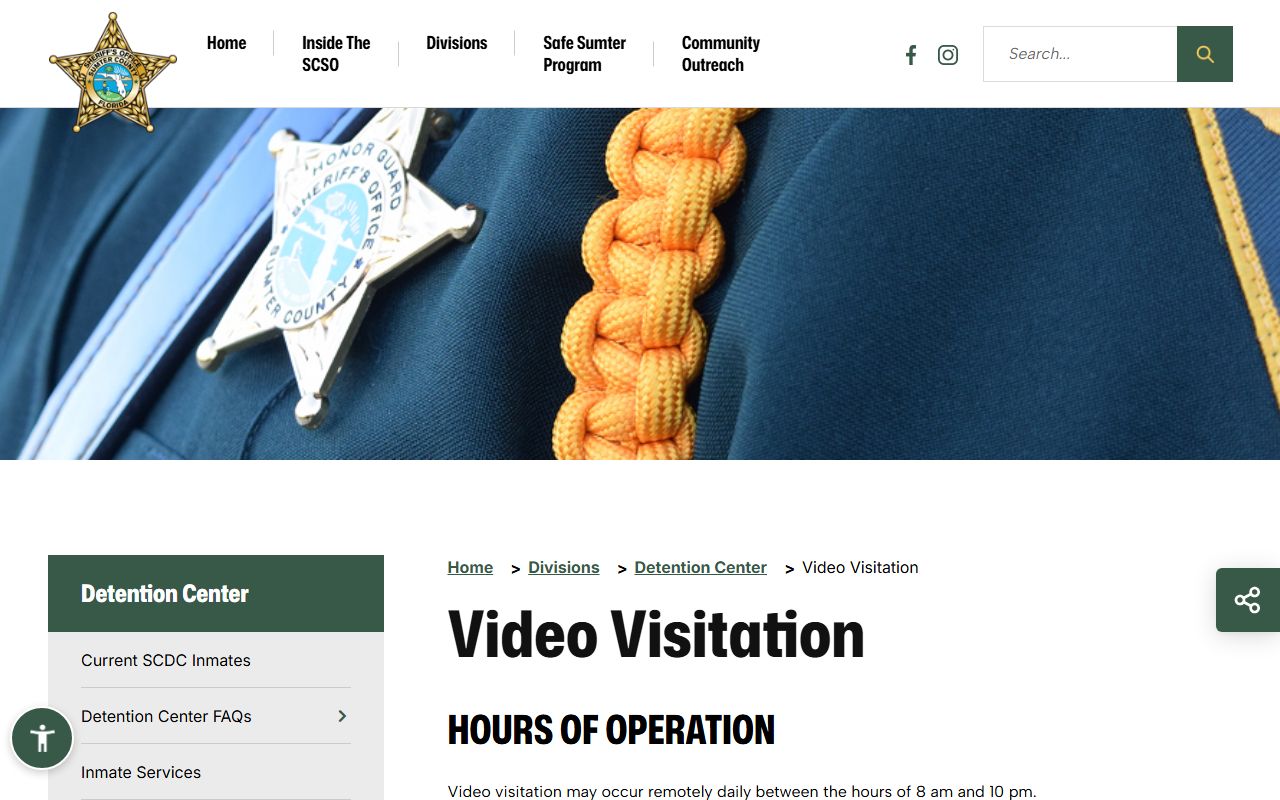
Because the provider and schedule can change, confirm both on the Sheriff's page before scheduling a visit.
How to Contact a Sumter County Inmate
Mail goes to the Sumter County Detention Center at 219 East Anderson Avenue, Bushnell, FL 33513. The inmate handbook says a mailbox sits in each cellblock, incoming mail is opened and inspected for contraband and may be monitored, and outgoing legal mail can be sealed. Phone accounts can be set up as collect or prepaid, the inmate phone company line is (800) 844-6591, and the current provider page lists HomeWAV for phone, tablet, and video service. All calls are recorded and may be monitored, and a phone PIN is assigned at intake.
Families often confuse a routine call with a private legal call. Social calls and messages are recorded, while privileged legal communication follows separate rules, so legal matters should be handled through counsel and the jail's legal-mail and attorney-visit process.
Commissary and Inmate Funds
Money carried in at booking is placed in the inmate account after a $20 subsistence fee. Friends and family can deposit money two ways: the public lobby kiosk at the intake and release facility, open 24 hours, or the visitation-center kiosk during visitation hours. The kiosks take cash, debit, and credit, but they only accept deposits and do not give cash back. Online deposits run through the commissary deposit vendor. The Sheriff's inmate services page lays out the money, phone, and program rules.
Some local rules are worth knowing before sending money. The facility does not accept checks or money orders, and cash sent by mail is not credited to the inmate account. A person counts as indigent only after seven straight days in custody with less than two dollars in the account and no commissary in the prior week. After release, a person may still owe the Detention Center for unpaid medical visits and the subsistence fee, and those payments go to a separate financial vendor in Kentucky, not to the jail. Commissary ordered before a release must be picked up within five business days or it is destroyed with no refund.
The Sheriff's inmate services page is the source for the deposit and commissary rules. The Sumter County inmate services page covers deposits, kiosks, phone setup, and indigent rules.
Commissary deposits and cash bond are handled at the same lobby kiosk but are not the same thing, so confirm which transaction you are making before paying.
Note: Confirm a person's current custody status and the accepted payment methods with the Detention Center before sending money or scheduling a visit.